Dalmatia
Vis
Komiža, Stiniva, the Blue Cave & the Far Adriatic
An island closed to the world
Vis is the farthest of the inhabited Dalmatian islands — fifty kilometres south-west of Split, alone in the deep Adriatic, the last large piece of land before the open run to the Italian coast. From 1949 to 1989, the island was a closed Yugoslav military base; foreigners were not permitted to land. The result, when Vis finally opened in the 1990s, was an Adriatic island that had been shielded from forty years of mass tourism and from the resort-building boom of the 1970s and 1980s. Vis emerged with its two stone harbours intact, its vineyards still in private hands, its konobas still serving what the families had always served.
For the luxury traveller in 2026, Vis is the most editorial of the Croatian islands — the one with the strongest sense of place, the quietest harbours at sunset, and the kind of small konoba dinners that have become almost impossible to find on Hvar or Korčula. It is also the island where the second Mamma Mia film was shot, which has changed traveller awareness without yet changing the island itself.
Vis Town and Komiža — the two harbours
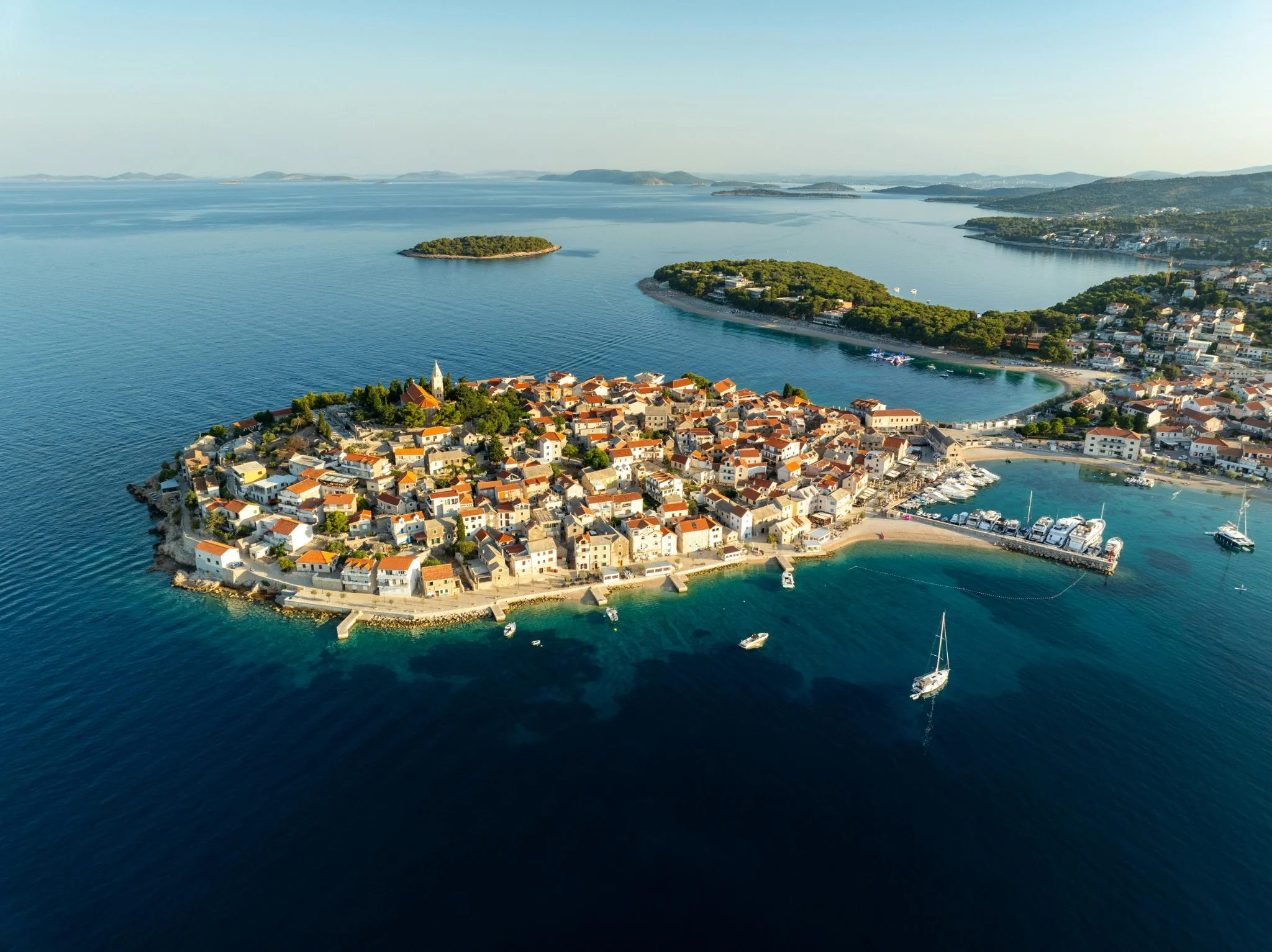
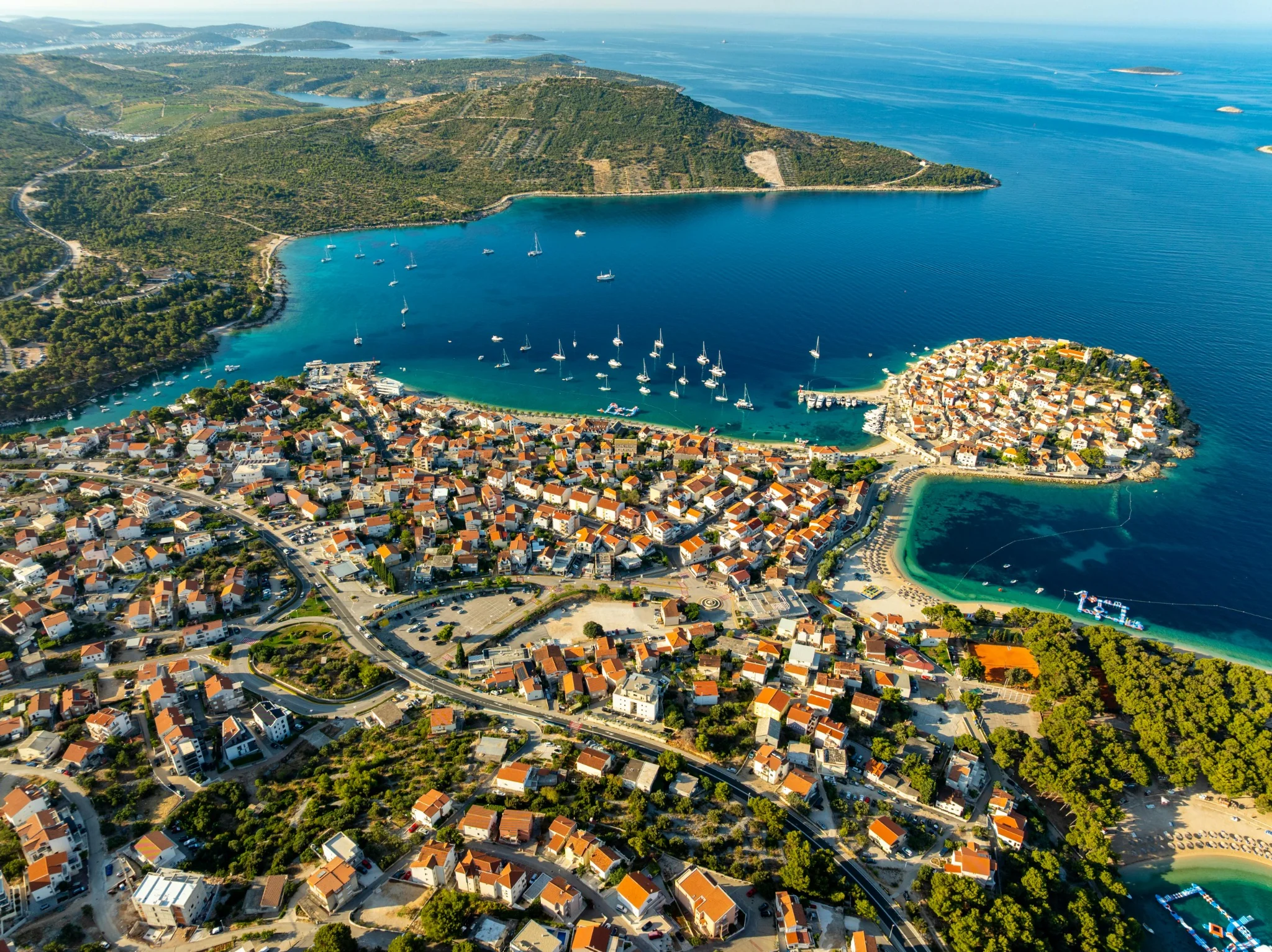
Vis has two settlements of any size and they sit at opposite ends of the island. Vis Town, on the eastern shore facing the mainland, is the larger of the two — a long arc of pastel stone houses around a deep harbour, with two beautiful sub-villages (Kut, the old fishing quarter, and Luka, the harbour itself) and the most important Greek archaeological site on the Adriatic at Issa. The yacht crowd anchors here in summer; the rest of the year it is an island town that goes about its own business.
Komiža, on the western shore, is the smaller and more atmospheric harbour — a tight crescent of stone houses around a horseshoe bay, looking west into a sunset over the open Adriatic. It is the historic fishing capital of the central Adriatic, the home port of Croatian sardine fishing for four hundred years, and the launching point for boat trips to the Blue Cave on Biševo. Most travellers fall in love with Komiža; many subsequently find an excuse to base their stay there.
Stiniva and the great beaches
Stiniva is the most spectacular beach on Vis and one of the most extraordinary on the Adriatic — a hidden cove on the southern coast where two limestone walls almost meet at the sea, leaving a narrow opening that hides the beach completely from the open water. The pebble bay inside is small, almost circular, and at the right time of day glows turquoise. Stiniva is reached by a steep walking path of about twenty minutes from the road above, or — much more commonly — by boat from Komiža; the latter is by far the more rewarding way to arrive. The other essential coves are Srebrna, on the southern coast, and Stončica, on the eastern shore — the rare Vis beach with sand.
The Blue Cave on Biševo
The Blue Cave (Modra Špilja) on the small island of Biševo, twenty minutes by boat from Komiža, is the single most famous natural attraction in this part of the Adriatic. At a specific window of late morning, sunlight enters through an underwater opening, refracts through the seawater, and lights the cave from below in a clear electric blue. The window is short — roughly 11 a.m. to 1 p.m., depending on season and conditions — and the cave is closed in any weather rougher than a moderate breeze. Private boat trips from Komiža are by far the most rewarding way to visit; tour-boat queues at the cave entrance can take an hour at peak, while a small private RIB can usually pick its window. Pair the visit with a swim at the Green Cave on Ravnik or a tender lunch at the small restaurant on Biševo.
Where to stay
Vis is deliberately not a hotel island — there are no large resorts, and the strongest stays are small, family-run, and considered.
- Hotel San Giorgio, Vis Town — the most polished small hotel on the island, set in a beautifully restored house in the Kut quarter. Eight rooms, a quiet courtyard, walking distance from the harbour restaurants.
- Issa Heritage Hotel, Vis Town — eighteenth-century stone, sympathetically modernised, on the inner harbour.
- Lemongarden Vis (in development) — the Brač-based group’s planned Vis property; check current status before booking.
- Private villa rentals — by far the strongest luxury option on Vis. Restored stone villas with pools have appeared above Vis Town, Komiža, and the eastern bays of Rukavac and Stončica. Concierge introductions on request.
Konobas and the Vis food story
Vis is the strongest food island in Croatia, and the konobas of the interior are the reason serious travellers come back. Konoba Roki’s in Plisko Polje is the institution — slow-cooked lamb and octopus peka served at long communal tables in an old stone barn, with the family’s own wine. Pojoda in Vis Town is the elegant fish restaurant in the Kut quarter, the best plate of grilled fish on the island. Senko in Mala Travna and Stončica beach restaurant are the unmissable boat-and-lunch destinations. Dionis in Komiža keeps the local fish-stew tradition alive.
The wines of Vis are uncommonly good. The indigenous white grape is Vugava — pre-Roman, intensely mineral, almost extinct elsewhere — and the indigenous red is Plavac Mali, here grown on island terraces rather than the mainland slopes of Pelješac. Lipanović, Roki’s, and Senjković are the producers worth a private visit.
How to get to Vis
Vis is reached only from Split, by either a 2-hour Jadrolinija car ferry or a faster Krilo catamaran (about 80 minutes) — both daily, year-round. There is no airport on Vis and no direct connection from any other island. For luxury travellers the most rewarding arrival is by chartered yacht from Split or Hvar, anchoring in Komiža for sunset; the run from Hvar takes around two hours. See our Croatia ferry & yacht guide for full transfer options.
Frequently asked questions
Is Vis worth visiting?
For travellers wanting the quietest, most editorial of the Croatian islands — strong food, beautiful harbours, almost no large hotels, and Stiniva and the Blue Cave within an hour by boat — Vis is the most rewarding island on the Adriatic. It is also the island most visibly unchanged by mass tourism, a direct legacy of its forty years as a closed military base.
How long should I spend on Vis?
Three nights is the minimum; four to seven nights at a private villa or in Komiža is ideal. Day trips from Hvar or Split do not do the island justice — Vis is two hours from the mainland and the two harbours are at opposite ends of the island.
When is the best time to visit Vis?
June and September are the connoisseur’s months — warm sea, settled weather, the konobas open, the harbours quieter than in midsummer. July and August are excellent but the marinas fill with chartered yachts and the Komiža harbour can be busy at sunset. Late May and early October still produce beautiful weather and very few travellers.
Was Mamma Mia 2 filmed on Vis?
Yes — Mamma Mia! Here We Go Again was filmed largely on Vis in 2017, with key scenes shot at Stiniva, Barjoska, and Stončica. The film’s release brought a step-change in international awareness of the island. Even so, Vis remains noticeably quieter than Hvar or Korčula.
Can you visit the Blue Cave from Vis?
Yes — the Blue Cave is on the small island of Biševo, twenty minutes by boat from Komiža on Vis itself. The most rewarding way to visit is by private RIB or small boat from Komiža, picking the late-morning light window when the cave is at its bluest. Tour-boat queues at the entrance can take an hour at peak season.
Is Vis better than Hvar?
They are different islands. Hvar is glamorous, sociable, and built around its old town and harbour scene. Vis is quieter, more remote, and built around its food, its two unspoiled harbours, and its unusually strong wine and konoba culture. Travellers wanting the nightlife of the Adriatic go to Hvar; travellers wanting its strongest sense of place go to Vis.
Plan your Vis trip
Vis pairs naturally with a Split or Hvar leg of a Dalmatian week — see our Split travel guide, our Hvar travel guide, and the 7-day Croatia itinerary for the canonical route. For the broader picture of Adriatic island travel, see our Croatia islands guide. For private boat days, villa introductions, or full Vis weeks, see our concierge enquiries page.