
Dalmatia
Split
Heart of Dalmatia
Welcome to Split
Split is unlike any other city on the Adriatic. The old town isn’t built next to a Roman palace — it is built inside one. When the emperor Diocletian retired here in 305 AD, he built a sprawling sea-facing residence that was, by the 7th century, repopulated by refugees who turned its halls and basements into streets, houses, and shops. Seventeen centuries later, those same Roman walls and substructures form the bones of one of the most extraordinary lived-in old towns in Europe — a UNESCO World Heritage Site since 1979 and the second-largest city in Croatia.
This Split travel guide covers the best things to do, where to eat, where to stay, and how to plan a luxury visit to the heart of Dalmatia.
Why Visit Split
Split is Croatia’s most rewarding city to wander. The old town is a maze of marble alleys, courtyards, and cellars hidden inside Diocletian’s Palace; the Riva (the seafront promenade) is the social heart of Dalmatia, lined with palms, cafes, and yachts; the Marjan peninsula offers Mediterranean pine forest and clifftop swimming spots a short walk from the centre; and Brač, Hvar, Vis, and Šolta are all within a one-hour ferry ride.
For luxury travelers, Split has matured rapidly in recent years — a wave of new fine-dining restaurants, refined boutique hotels inside Roman palace halls, and excellent yacht-charter operators have turned what was once mostly a transit hub for the islands into a destination in its own right.
Top Things to Do in Split
- Explore Diocletian’s Palace. The walled old town. Walk through the Bronze, Silver, and Iron gates; descend into the cathedral-quiet Substructures; emerge into the Peristyle, the open-air central court of the original palace, still in use after 1,700 years.
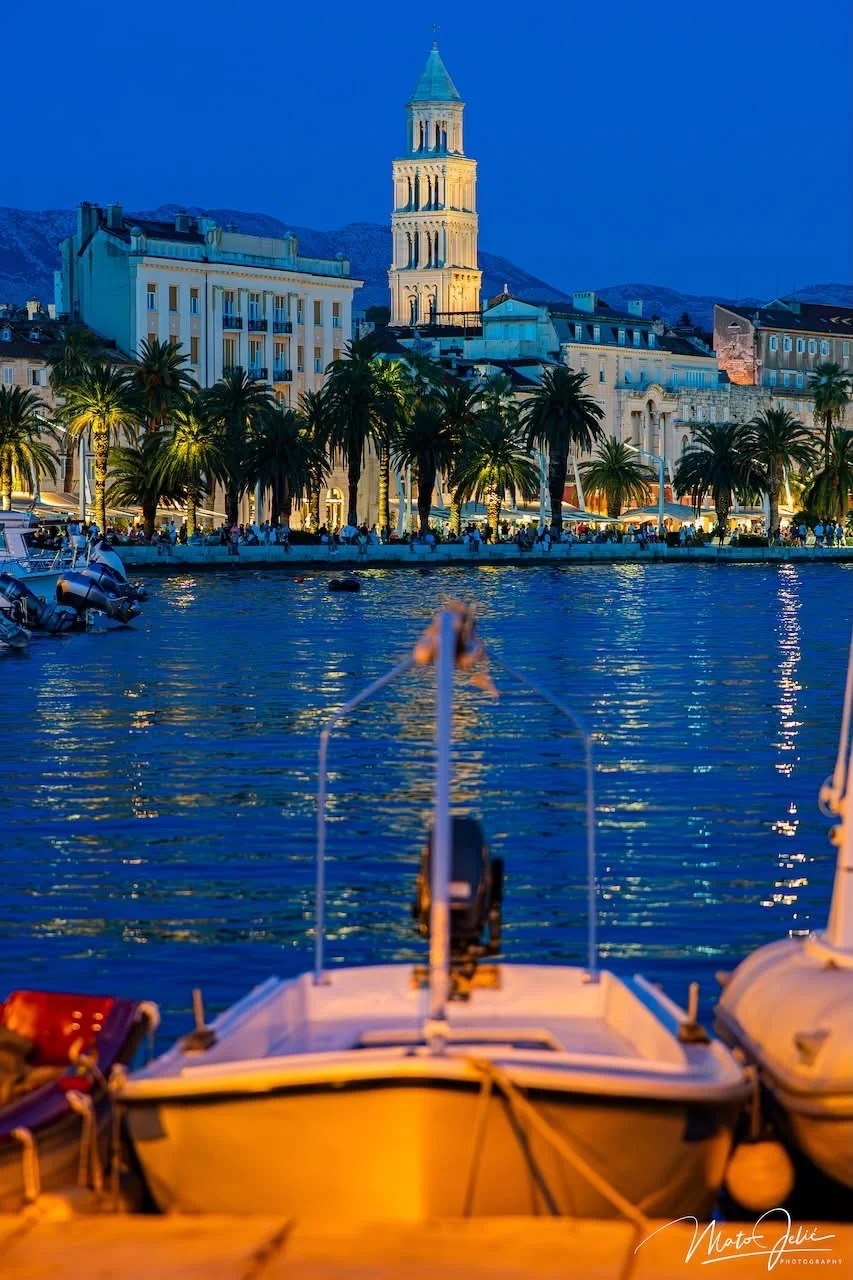
- Climb Saint Domnius Bell Tower. The 13th-century tower stands directly over Diocletian’s mausoleum (now the cathedral). The 200-step climb is steep but rewards you with the best panoramic view in Split.
- Stroll the Riva at golden hour. Split’s marble waterfront promenade is at its best in the hour before sunset — every Splitcanin in the city seems to walk it before dinner.
- Hike Marjan Hill. The pine-covered peninsula at the western edge of the old town. The 178-metre summit gives panoramic views over Split, the islands, and the Mosor mountains; the cliffs below have small, crystal-clear swimming spots.
- Visit the Mestrovic Gallery. Croatia’s greatest 20th-century sculptor lived and worked here — his hilltop atelier and gardens above Marjan are among the loveliest museums in the country.
- Day trip to Brač for Zlatni Rat. Croatia’s most famous beach — the shape-shifting white pebble spit that points like a tongue into the Adriatic — is a one-hour ferry from Split.
- Explore Krka National Park. An hour up the coast lies the country’s second-most-spectacular waterfall park — fewer crowds than Plitvice, with cascades you can swim beneath.
- Day trip to Trogir. The UNESCO old town of Trogir is just 30 minutes from Split — perfectly preserved medieval architecture on a tiny island.
- Sail to Vis or the Pakleni Islands. A private boat from Split’s marina opens up the most beautiful sailing waters in central Dalmatia — the Blue Cave on Biševo, the green coves of Vis, the bare-rock beaches of the Pakleni archipelago.
Where to Eat in Split
Split’s food scene has quietly become one of the strongest in Croatia. Dužet Restaurant at the Hotel Park is the refined fine-dining choice, with a sea-view terrace and a creative Dalmatian-modern menu. Bokeria Kitchen & Wine, in a 19th-century covered market just outside the palace walls, does inventive Mediterranean cooking with one of the best wine lists in the city. Konoba Matejuška hides in a tiny alley near the Riva and serves the kind of seafood Splitcanin actually eat at home. For a casual lunch, Zinfandel Food & Wine Bar tucks into a stone-walled palace-hall, and Bajamonti on Republic Square is the long-standing classic for a coffee, an aperitif, or dinner watching the Riva go by.
Where to Stay in Split
For luxury inside the walls, Heritage Hotel 19, Palace Judita Heritage Hotel, and Vestibul Palace all occupy restored Roman palace halls and offer suites with original 1,700-year-old stonework. Hotel Park, on a leafy hill east of the old town, is the upscale resort-style choice with a celebrated restaurant. Le Méridien Lav, a 15-minute drive south at Podstrana, is the largest five-star resort with a marina and spa. Many luxury travelers also charter a yacht and sleep on the water — Split’s ACI marina is one of the best-equipped on the Adriatic.
How to Get to Split
Split has its own international airport (SPU), 25 km west of the city near Trogir, with direct flights from across Europe and seasonal connections from North America. From the airport, the bus or a taxi reaches the old town in 30–40 minutes. Split is also Croatia’s main ferry hub, with daily catamaran connections to Hvar, Korčula, Brač, Vis, and Dubrovnik. From Zagreb, the A1 motorway delivers you to Split in about 4 hours.
Best Time to Visit Split
Late May, June, and September are the sweet spots — warm sea, long evenings, manageable crowds, and full restaurant calendars. July and August are spectacular but very busy, especially during the Ultra Europe music festival in mid-July. April and October are quieter shoulder months — the sea is cool but the city is at its most peaceful. Winter Split is atmospheric and far less visited; many smaller konobas close, but the old town feels reclaimed by locals.
Practical Tips
- The old town is entirely pedestrian — use the public garages outside the walls.
- The cathedral is closed during Mass; check times before climbing the bell tower.
- For Marjan Hill, start early morning before the heat builds, or save it for golden hour.
- Ferry tickets to the islands sell out in summer — book online a day or two ahead via the Jadrolinija or Krilo apps.
- The Pazar (open-air market) just east of the palace walls is open daily and is the freshest place to assemble a picnic.
Frequently Asked Questions
Is Split worth visiting?
Yes — Split is one of the most rewarding cities on the Adriatic and the natural base for exploring central Dalmatia. The old town is built inside Diocletian’s 1,700-year-old Roman palace, the Riva is one of the loveliest waterfront promenades in the Mediterranean, and Split is the ferry hub for Hvar, Brač, Korčula, and Vis. Plan two to three nights minimum.
How many days do you need in Split?
Two full days for Split itself — one for Diocletian’s Palace and the old town, one for Marjan Hill and a long lunch on the Riva — and add days for the islands. A typical luxury Dalmatian trip uses Split as a base for 3–5 nights with day-trips to Trogir, Krka, Hvar, and Brač.
What is Split known for?
Split is known for Diocletian’s Palace — a UNESCO World Heritage Site since 1979 and the heart of the modern old town — for its Riva waterfront promenade, the climb up Marjan Hill, and as the ferry gateway to the central Dalmatian islands. The city also has a strong food scene and an annual Ultra Europe music festival in July.
Is Split better than Dubrovnik?
They are different. Dubrovnik is more concentrated and more spectacular as a single visual object — the walled old town is unmatched in the world. Split is larger, livelier, more lived-in, and a much better hub for island-hopping. Most travelers visit both on a 7–10 day Dalmatian itinerary.
What is the best month to visit Split?
June and September are the perfect months — warm sea, long evenings, manageable crowds, full restaurant calendars, and the islands are at their best. May and early October are quieter and lovely. July and August are spectacular but very busy and significantly hotter, with cruise tenders adding daytime crowds in the old town.
Plan Your Croatia Trip
Split is the natural base for exploring central Dalmatia — pair it with Hvar, Brač, Trogir, Šibenik, Omiš, and the islands of central Dalmatia. See our 7 Day Croatia Itinerary and Croatia Travel Guide for trip planning ideas.
For private boat days, villa introductions, or full Croatian weeks, see our concierge enquiries page.